
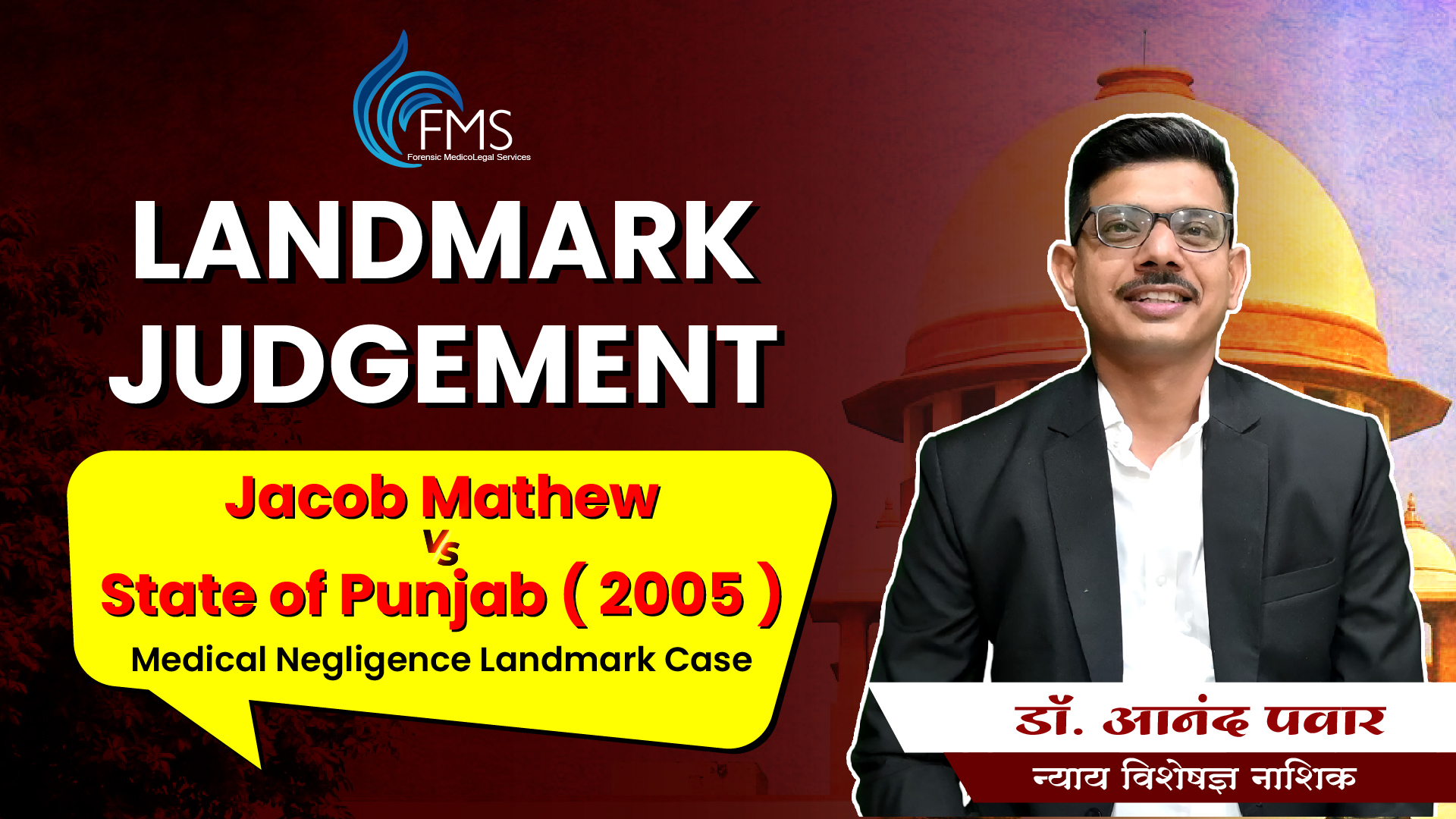
Jacob Mathew v. State of Punjab – Detailed Chronology and Analysis of a Landmark Medical Negligence Case
Case Number
Jacob Mathew v. State of Punjab & Anr.
AIR 2005 SC 3180; (2005) 6 SCC 1
Court
Supreme Court of India
Bench: Chief Justice R.C. Lahoti, Justice Gopal Goswami, and Justice P.K. Balasubramanyan
Date of Judgment
5 August 2005
Relevant Laws and Sections
Indian Penal Code – Section 304A (Causing death by negligence), Section 34 (Common intention)
Code of Criminal Procedure – Section 482 (Inherent powers of the High Court)
1. Background of the Case
Patient: Jeevan Lal Sharma, terminal cancer patient.
Place of Admission: CMC Hospital, Ludhiana – Private Ward.
Complaint: Death alleged due to medical negligence, specifically the use of an empty oxygen cylinder.
Offence Registered: IPC Sections 304A and 34.
2. Detailed Chronology
15 February 1995 – Patient admitted with complaints of chest pain, breathlessness, and fatigue. Preliminary investigations and treatment initiated.
15–22 February 1995 – Regular medication continued; mild breathlessness was intermittently controlled.
22 February 1995 (Night):
10:45 PM: The patient reported feeling restless and experiencing difficulty breathing.
11:00 PM: Severe respiratory distress; the family informed the nurse.
11:05 PM: Doctors were called over the phone.
11:15 PM: Dr. Jacob Mathew and Dr. Allan Joseph arrived; they decided to start oxygen therapy.
11:16 PM: Oxygen cylinder found empty; a delay occurred in bringing a replacement.
11:30 PM: CPR performed; however, death was declared.
3. Allegations
Negligence, delay, and non-availability of essential equipment by doctors and staff.
The death of the patient occurred directly due to this negligence.
4. Arguments
For the Petitioner (Dr. Jacob Mathew):
- The patient was already in a terminal stage of illness.
- The lapse was administrative in nature; there was no criminal intent.
- To constitute a criminal offence, “gross negligence” must be proved.
For the Respondent (State/Family):
- The doctors did not respond in time.
- Death resulted from a lack of equipment and failure in emergency management.
5. Court’s Observations
There is a distinction between simple negligence and criminal negligence.
“Bolam Test” – If a doctor acts in accordance with a practice accepted by a responsible body of medical professionals, it cannot be considered negligence.
Before lodging an FIR, it is necessary to obtain an expert medical opinion.
Administrative lapses should not automatically translate into criminal liability for doctors.
6. Decision
The Supreme Court set aside the High Court order and quashed criminal proceedings.
Holding:
“Without proven and gross negligence, IPC Section 304A cannot be applied to medical professionals.”
7. Guidelines for Doctors and Hospitals (Dos & Don’ts)
Dos:
- Ensure continuous availability of emergency equipment (oxygen, medicines).
- Record and maintain the requirement that no criminal action should be initiated without expert medical opinion.
- Keep documentation clear, detailed, and time-specific.
Don’ts (for Police):
- Do not initiate criminal proceedings for minor procedural or human errors.
- Do not register an FIR without obtaining an expert medical opinion.
8. Take-Home Message
In the medical field, mere negligence is not sufficient for criminal liability; gross negligence must be clearly established.
Expert medical opinion and proper legal procedure are mandatory.
Doctors should not be made scapegoats for administrative or systemic lapses.